 Skip to content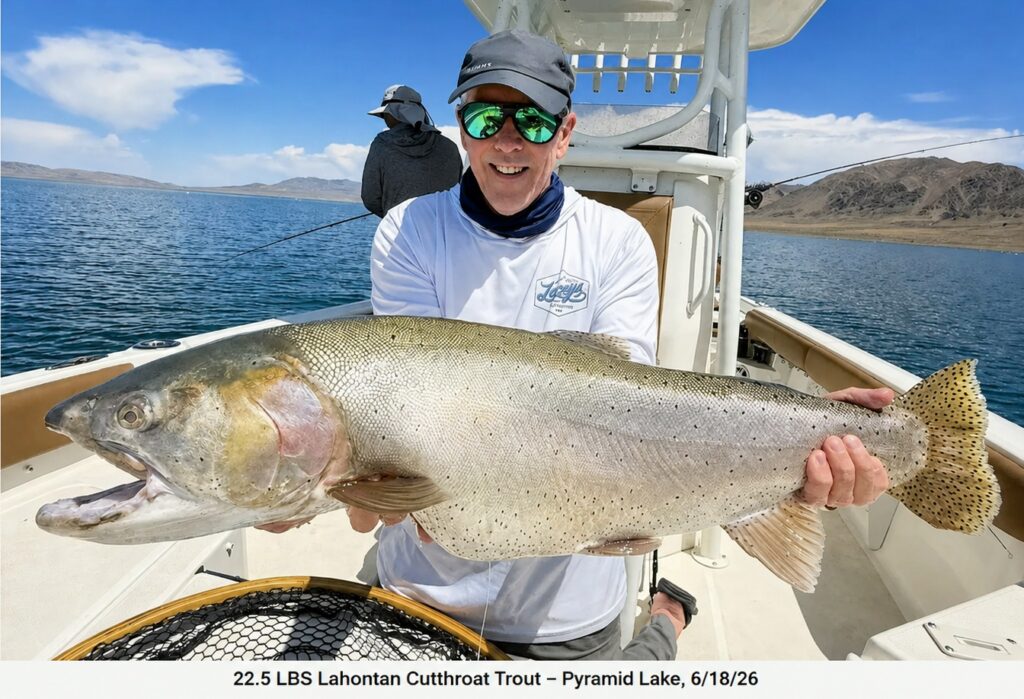
Fishing Pyramid Lake is unlike fishing anywhere else in the world.
Located in northern Nevada, Pyramid Lake is a massive high-desert lake famous for Lahontan Cutthroat Trout—and for producing some of the largest cutthroat trout on the planet.
Historically, Pyramid Lake produced Lahontan Cutthroat Trout exceeding 40 pounds, including the legendary 41-pound class trout that remains part of the lake’s fishing history.
Today, after the original Pyramid Lake population disappeared from its native waters more than 80 years ago, giant Lahontan Cutthroat Trout are once again swimming the lake.
And they’re getting bigger.

The return of the Pilot Peak strain, major changes in stocking, the importance of Tui Chub as a food source and a better understanding of how these trophy trout move throughout an enormous body of water have transformed the way anglers fish Pyramid Lake.
Traditional ladder fishing and springtime indicator fishing remain important. But they are no longer the entire story.
Today’s anglers can fly fish, jig, troll, fish from shore or use a boat to search miles of water for bait and feeding trout.
Perhaps the biggest change is this:
Pyramid Lake is no longer primarily a numbers lake. It has become a SIZE lake.
This complete guide covers the history of the fishery, how Pyramid Lake has changed, the best times to fish, and the techniques anglers use today to target its giant Lahontan Cutthroat Trout.

Pyramid Lake Nevada – A Massive High-Desert Lake
Before talking about how to fish Pyramid Lake, it helps to understand the scale of the place.
Pyramid Lake covers approximately 112,000 acres, stretches roughly 27 miles from north to south, reaches approximately 11 miles across at its widest point, has more than 70 miles of shoreline, and reaches depths of around 350 feet.
That’s an enormous amount of water for an angler to figure out.

The lake’s size is one reason location, seasonal movement and depth are so important.
Finding Lahontan Cutthroat Trout in Pyramid Lake isn’t simply about choosing the right fly or lure.
You first need to find the fish.
Lake Tahoe, the Truckee River and Pyramid Lake

Pyramid Lake is also part of one of the West’s most remarkable connected water systems.
The water begins high in the Sierra Nevada.
Lake Tahoe feeds the Truckee River, which is Tahoe’s only surface-water outlet. The Truckee flows out of Lake Tahoe, through the Sierra Nevada, across Reno and northern Nevada and ultimately enters Pyramid Lake.
And that’s where the water stops.
Pyramid Lake has no outlet.
It is a terminal lake, meaning water leaves primarily through evaporation rather than flowing downstream into another river or lake.
The connection is simple:
Lake Tahoe → Truckee River → Pyramid Lake
But that connection is about much more than water.
It is also central to the history—and now the recovery—of Pyramid Lake’s Lahontan Cutthroat Trout.
Why Pyramid Lake is a World-Class Trout Fishery
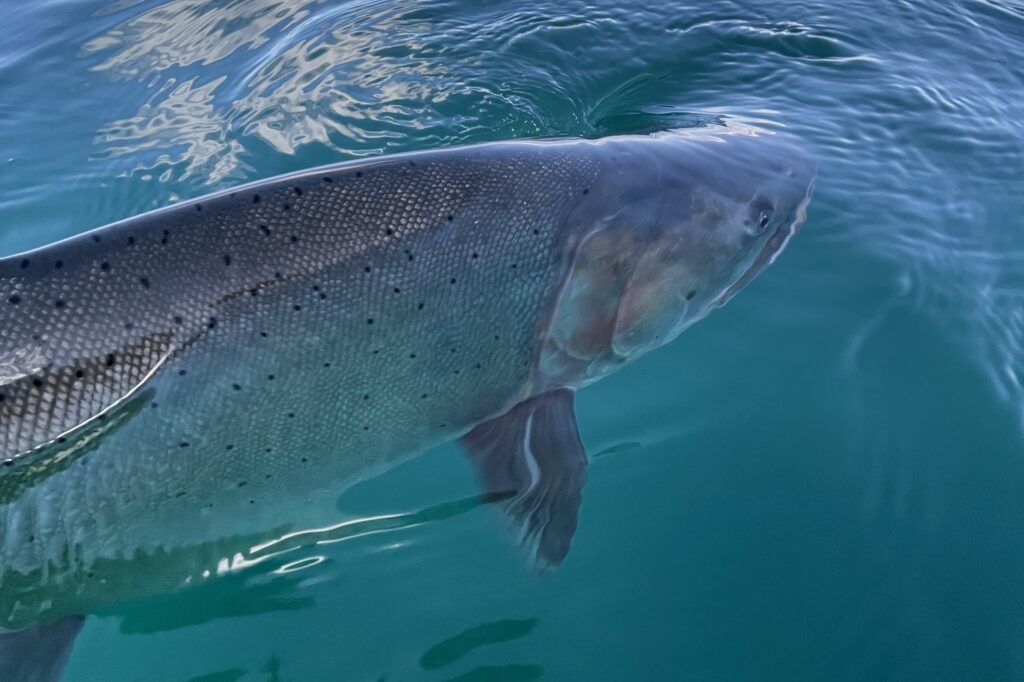
Pyramid Lake is one of the most unique trout fisheries in North America.
Its enormous size, depth, high-desert environment and food supply create conditions capable of producing exceptionally large Lahontan Cutthroat Trout.
These fish aren’t simply oversized versions of ordinary stream trout.
Large Lahontan Cutthroat are powerful predators capable of feeding heavily on baitfish, particularly Tui Chub.
And Pyramid Lake gives them an enormous amount of water in which to grow.

For decades, catching a 10-pound trout at Pyramid Lake was considered a major accomplishment.
Today, 10 pounds is no longer the ultimate benchmark.
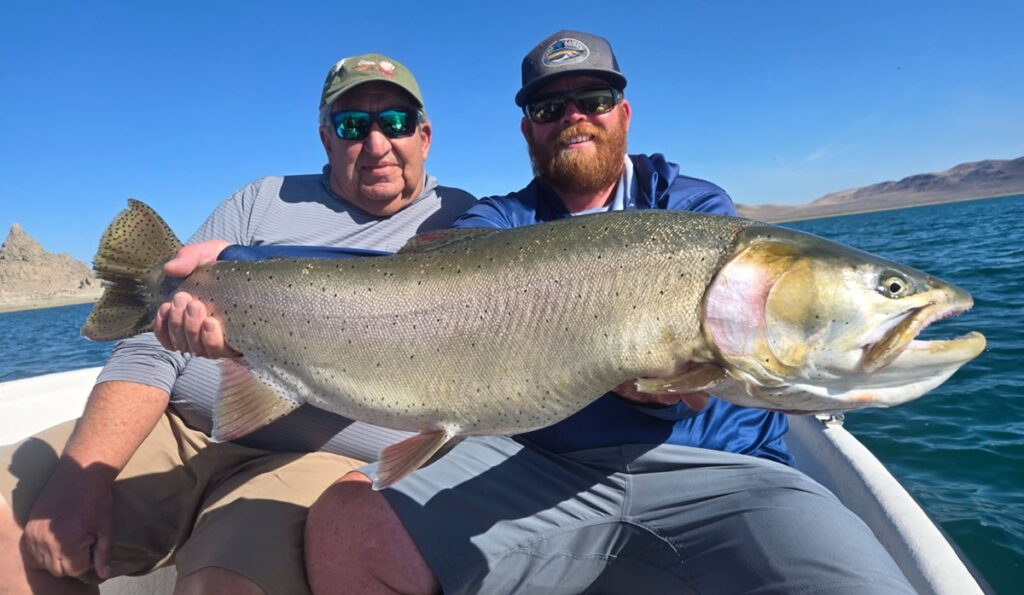
Fish exceeding 15 pounds are caught, and Lahontan Cutthroat Trout over 20 pounds are once again a legitimate possibility.
To understand why that’s so significant, we need to go back to the original Pyramid Lake trout.
The Original Giant Lahontan Cutthroat Trout of Pyramid Lake
Lahontan Cutthroat Trout evolved within the ancient Lake Lahontan system that once covered a vast portion of the Great Basin.
Pyramid Lake is one of the major remnants of that ancient lake.
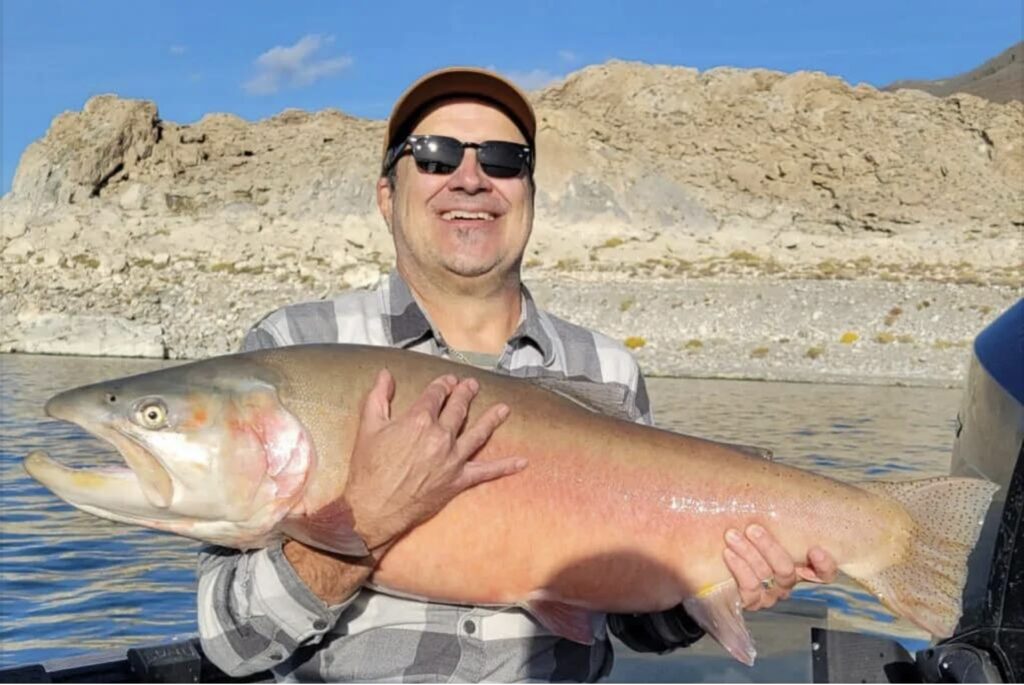
Historically, enormous Lahontan Cutthroat Trout inhabited Pyramid Lake and migrated into the Truckee River to spawn.
These were extraordinary fish.
Lahontan Cutthroat Trout exceeding 40 pounds were documented from the Pyramid Lake system, including the famous 41-pound class trout associated with the lake’s fishing history.
These trout were the apex predators of an enormous lake-and-river ecosystem.
But by the beginning of the twentieth century, that fishery was under tremendous pressure.
How Pyramid Lake Lost Its Original Lahontan Cutthroat Trout

Commercial fishing on Pyramid Lake grew dramatically during the late 1800s.
Between 1873 and 1922, approximately 100,000 to 200,000 pounds of Lahontan Cutthroat Trout were commercially harvested annually from the Pyramid Lake and Truckee River system.
That level of harvest put enormous pressure on the population.
But fishing pressure wasn’t the only problem.
In 1905, Derby Dam was constructed on the Truckee River as part of a federal irrigation project.
Water that historically flowed toward Pyramid Lake was diverted.
River flows changed.
Lake levels declined.
And, critically, Lahontan Cutthroat Trout lost access to important spawning habitat within the Truckee River system.
Pollution, habitat degradation and introduced fish added further pressure.
The combination proved devastating.
By the late 1930s and early 1940s, the giant native Lahontan Cutthroat Trout that had made Pyramid Lake famous were disappearing.
By the 1940s, the original Pyramid Lake population was gone from its native waters.
A trout capable of exceeding 40 pounds had essentially disappeared from Pyramid Lake.
For decades, it appeared those genetics had been lost forever.
They hadn’t.
Rebuilding the Pyramid Lake Fishery – The Summit Lake Strain
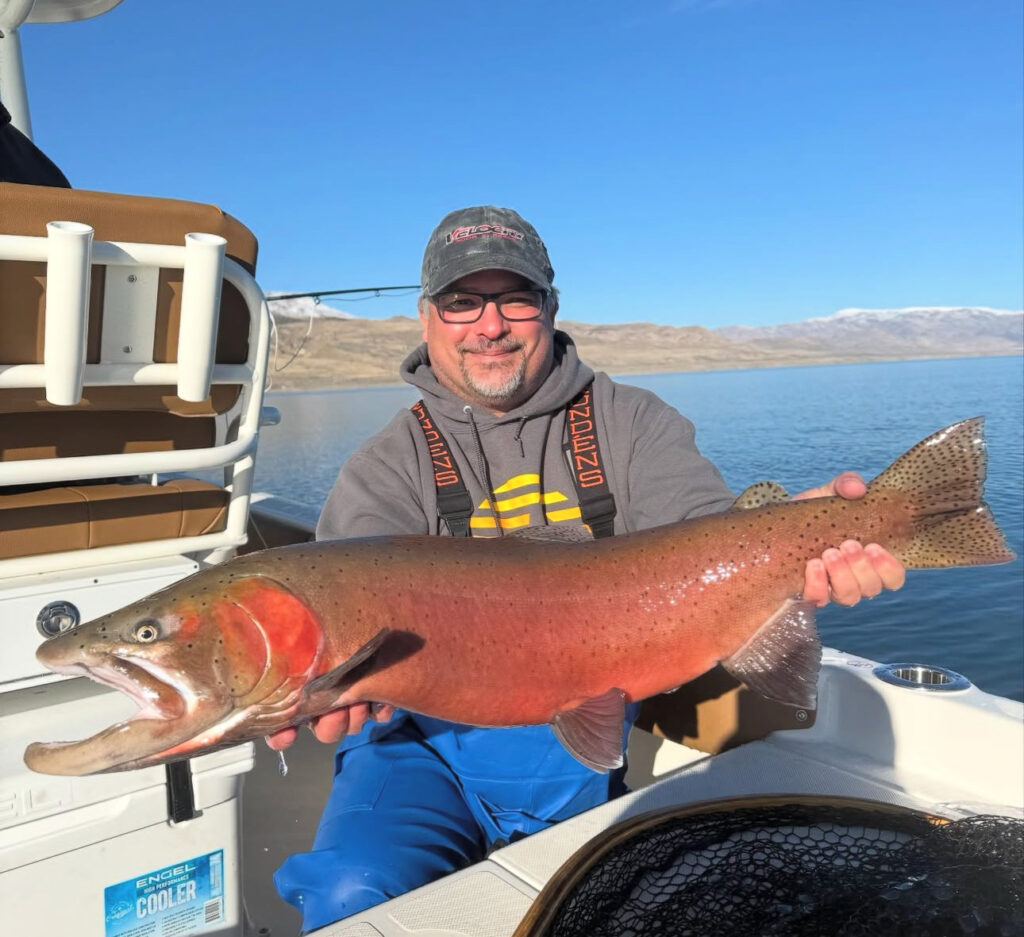
Pyramid Lake eventually became a trout fishery again through hatchery programs using Lahontan Cutthroat Trout from other populations.
The Summit Lake strain became a major component of the restored fishery.
These fish did exceptionally well from a numbers standpoint.
By the early 2000s, Pyramid Lake’s hatchery program was producing and stocking enormous numbers of Lahontan Cutthroat Trout.
Approximately 1 to 2 million trout could be stocked annually.
There were a lot of fish.
Many were in the 17- to 22-inch range, while catching a trout exceeding 10 pounds remained a major accomplishment.
But the sheer number of trout created extraordinary fishing.

When Pyramid Lake Was a Numbers Lake
March, April and into May became legendary.
Large numbers of Summit strain trout moved toward shallow water during the spawning period.
Indicator fishing with midges and nymphs exploded in popularity.
Ladder anglers could experience incredible fishing when large concentrations of trout moved along the shoreline.
Thirty- to 50-fish days were possible.
For many anglers, this became the definition of Pyramid Lake:
March and April.
Ladders.
Indicators.
Lots of fish.
And there is an important point to understand about that history:
Much of the legendary spring shore bite was a Summit strain bite.
Then another Lahontan Cutthroat strain entered the picture.
And Pyramid Lake began changing again.
The Return of the Pilot Peak Lahontan Cutthroat Trout
In the Pilot Peak Mountains near the Nevada-Utah border, an isolated population of Lahontan Cutthroat Trout had survived far away from Pyramid Lake.
Genetic research eventually linked these trout closely to the historic lake-form Lahontan Cutthroat that once inhabited the Truckee River–Pyramid Lake system.
In other words, genetics associated with the giant trout thought to have disappeared had survived.
After years of conservation and hatchery work, Pilot Peak strain Lahontan Cutthroat Trout began being stocked into Pyramid Lake in 2006.
The results were remarkable.
Pilot Peak trout demonstrated characteristics associated with the historic lake-form fish:
Large size.
Long life.
Predatory behavior.
A strong tendency to eat other fish.
They began feeding heavily on Pyramid Lake’s abundant baitfish.
And they began growing.

How Stocking at Pyramid Lake Changed
The return of the Pilot Peak strain occurred as the overall stocking strategy was also changing.
During the high-volume stocking years, Pyramid Lake could receive approximately 1 to 2 million trout annually.
Today, the lake doesn’t receive anything approaching those historic numbers.
The U.S. Fish & Wildlife Service’s Lahontan National Fish Hatchery produces Pilot Peak Lahontan Cutthroat Trout as part of a broader conservation and recovery program, with those fish distributed among multiple waters within the Lahontan system rather than all being stocked into Pyramid Lake.
The result is an important change for anglers.
There are fewer trout in Pyramid Lake than during the old high-volume stocking era.
But something else happened at the same time.
The fish got much bigger.

Pyramid Lake Is No Longer a Numbers Lake – It's a Size Lake
This may be the single most important thing an angler needs to understand about fishing Pyramid Lake today.
Twenty years ago, anglers could come to Pyramid Lake hoping to catch large numbers of trout—and perhaps get a shot at the elusive 10-pounder.
Today, we approach the lake differently.
Pyramid Lake has evolved from primarily a numbers fishery into a trophy fishery.
The Pilot Peak strain is a major reason why.
These trout have tremendous growth potential.
They’re highly predatory.
They chase bait.
They roam.
They utilize deep water.
And they grow.

What Does a Great Day at Pyramid Lake Look Like Today
Expectations need to change along with the fishery.
If you’re coming to Pyramid Lake expecting the 30-, 40- or 50-fish days associated with portions of the old high-density fishery, that isn’t what defines today’s lake.
There may be fewer opportunities.
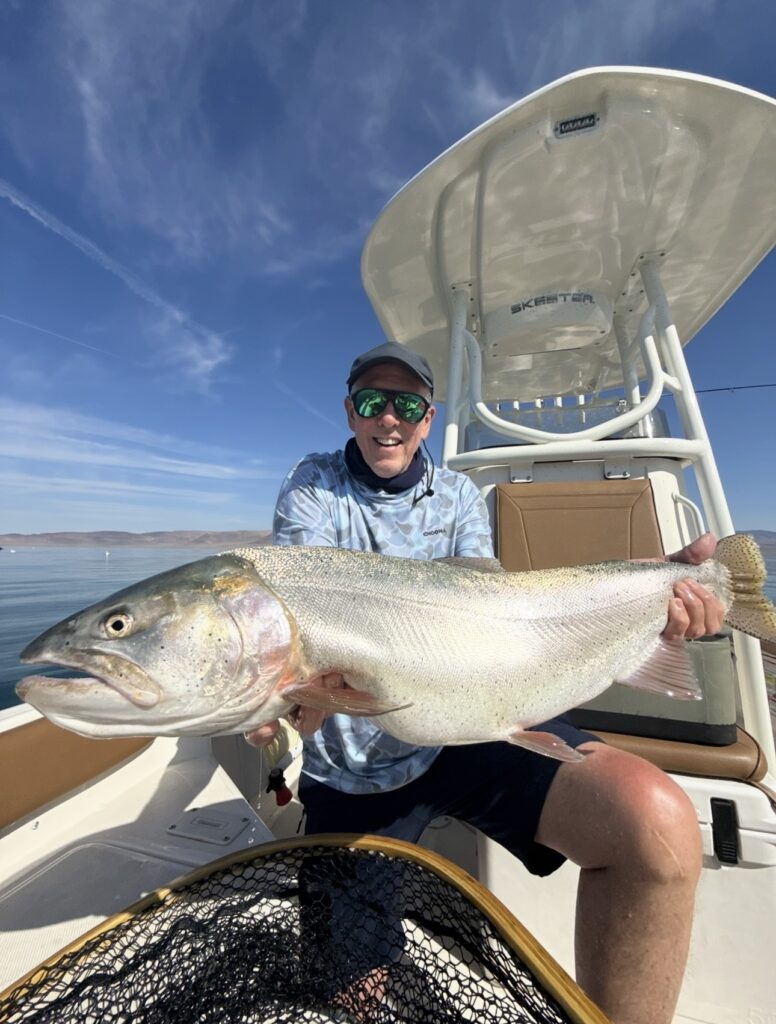
But one of those opportunities could be a 15-, 20-, or even 25-plus-pound Lahontan Cutthroat Trout.
We’ve watched that transformation firsthand.
In 2021, our guide service landed more than 100 Lahontan Cutthroat Trout to our boat, including one angler caught 15 fish over 10 pounds.
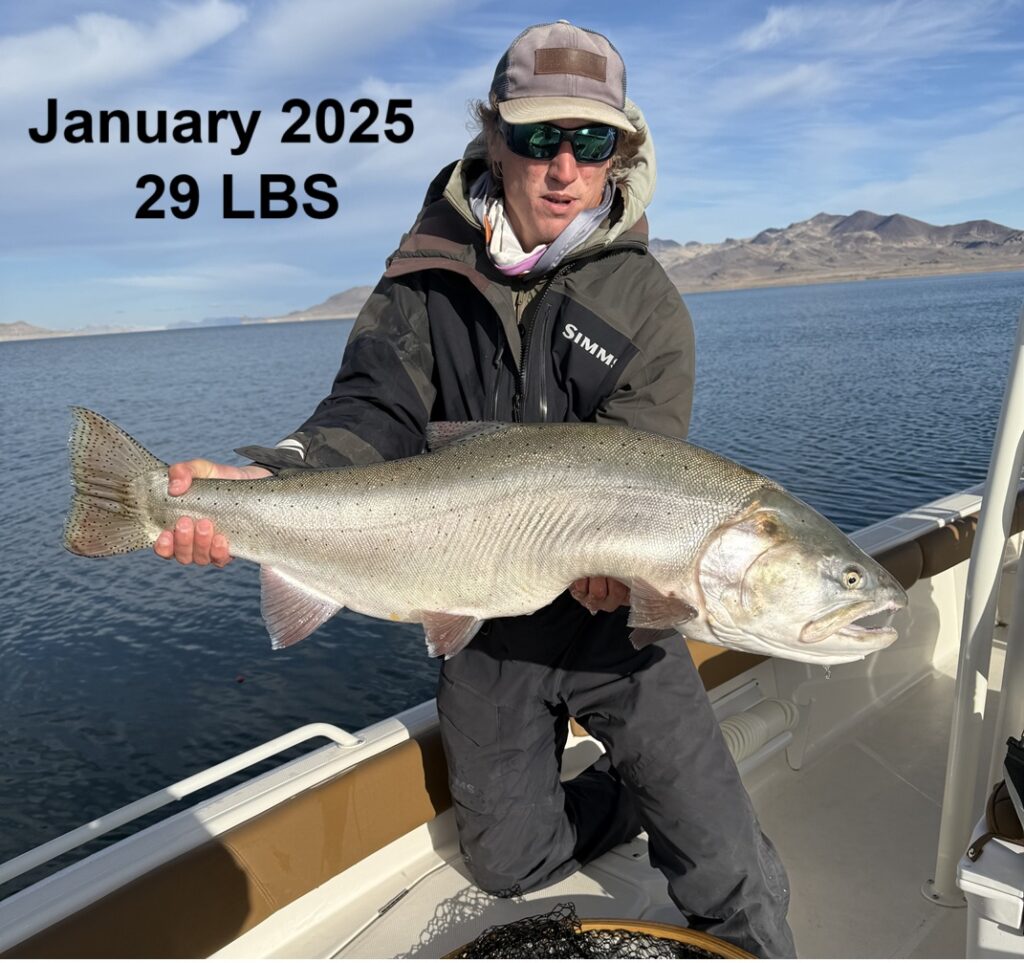
A 29-pound Lahontan Cutthroat Trout was landed on a Lacey’s Guide Service trip in January 2025.
Then came June 2026.
During more than 100 guided trips in June 2026, our anglers landed over 25 Lahontan Cutthroat Trout weighing 20 pounds or more—including one angler who caught three 20-pounders.
Think about that compared with Pyramid Lake 20 years ago, when a single 10-pound trout represented a major achievement.
That’s modern Pyramid Lake. Fewer fish. Bigger fish.
Summit and Pilot Peak Trout in Pyramid Lake Today
The transition hasn’t happened overnight.
Summit/Pyramid lineage Lahontan Cutthroat Trout and Pilot Peak trout have shared Pyramid Lake, creating a fishery that continues to evolve.
Because multiple Lahontan lineages now inhabit the system, their genetics, reproduction and interaction remain part of the continuing management of the Pyramid Lake–Truckee River fishery.
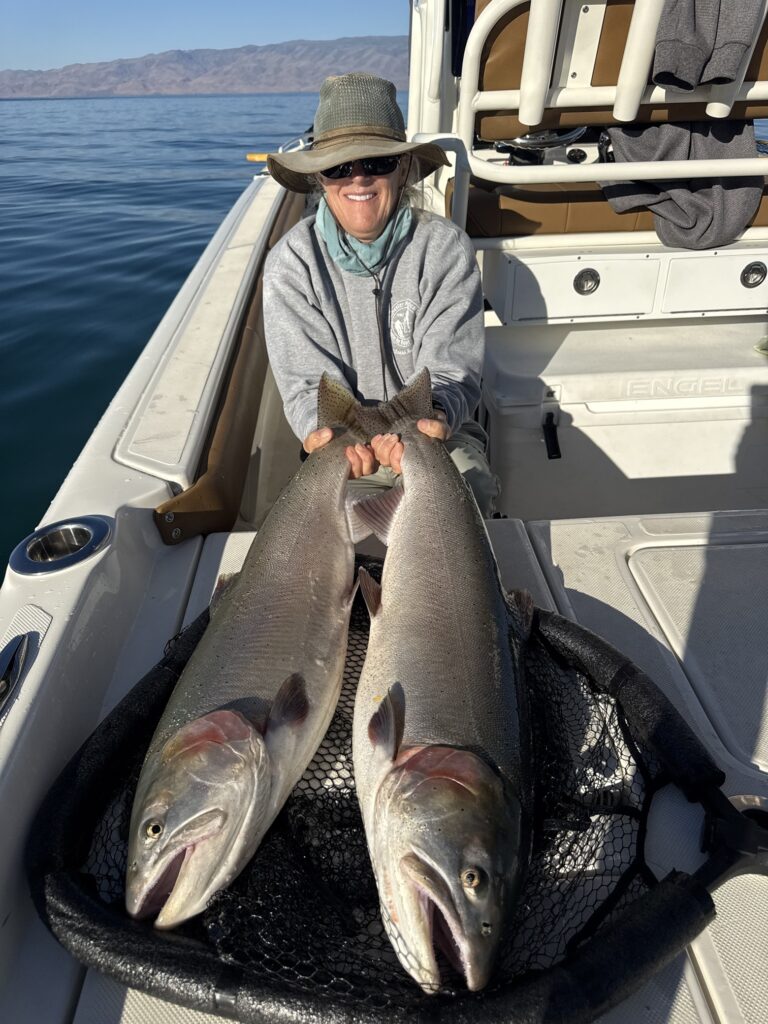
For anglers, the most obvious change has been the behavior and size potential of the Pilot Peak fish.
They’re not simply larger versions of the trout anglers were catching 20 years ago.
They’re highly predatory and strongly associated with baitfish.
That has changed the way we think about fishing Pyramid Lake.
Follow the Tui Chub – Find the Bait, Find the Trout
If there is one concept that helps explain modern Pyramid Lake fishing, it is this:
Find the bait and you have a much better chance of finding the trout.
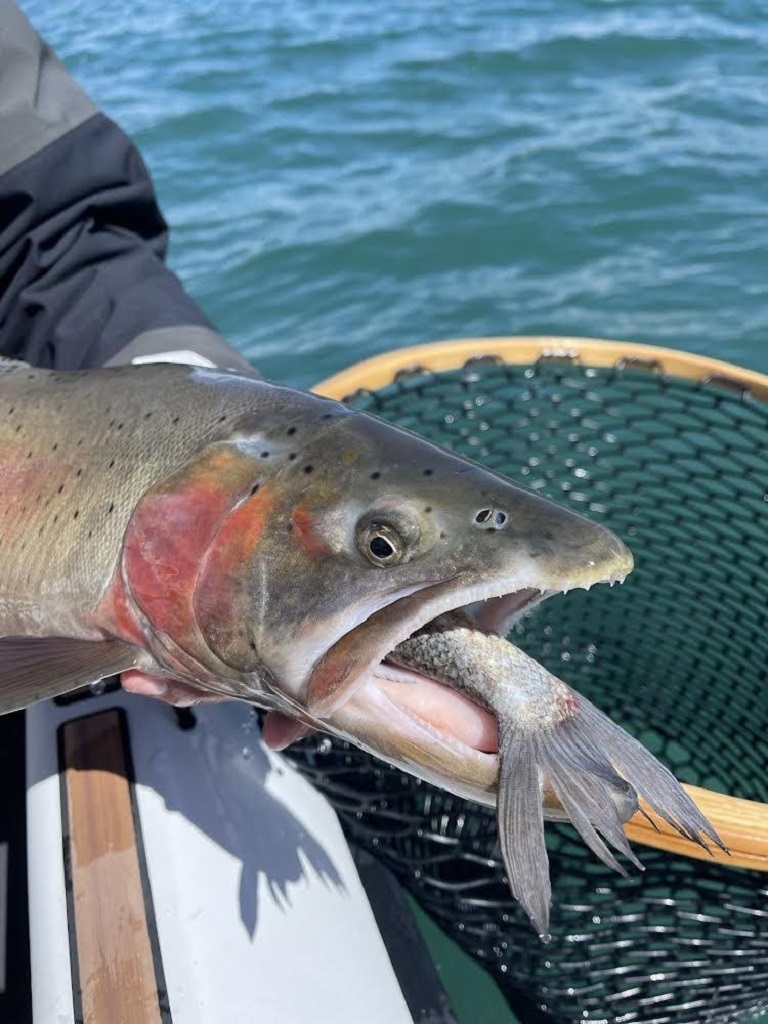
Tui Chub are one of Pyramid Lake’s primary forage fish and an extremely important food source for large Lahontan Cutthroat Trout.
Their location changes throughout the year as water temperature, oxygen levels and seasonal conditions change.
The trout move with them.
During warmer periods, Tui Chub can occupy portions of the water column where conditions offer them some protection from predatory trout.
The Lahontan can position themselves in cooler water below or adjacent to the bait, moving in to feed.
Understanding this relationship has completely changed how we approach portions of the Pyramid Lake season.
Instead of simply asking:
“Where are the trout?”
We often begin with:
“Where is the bait?”

Lahontan Cutthroat Trout Are Returning to the Truckee River
One of the most exciting parts of the Pilot Peak story isn’t happening in the middle of Pyramid Lake.
It’s happening back in the Truckee River.
Historically, Lahontan Cutthroat Trout migrated from Pyramid Lake into the Truckee River to spawn.
That migration disappeared along with the lake’s original trout population.
Now we’re seeing it again.
Pilot Peak Lahontan Cutthroat Trout have been documented leaving Pyramid Lake and migrating into the lower Truckee River.
During the 2021 spawning season, 1,545 Pilot Peak Lahontan Cutthroat Trout were recorded at the Marble Bluff Fish Passage and Research Facility.
These aren’t simply hatchery trout being placed into a lake and growing large.
They’re exhibiting the migratory behavior of the historic fish.
They’re leaving Pyramid Lake.
They’re entering the Truckee River.
They’re attempting to reproduce.
They’re using water Lahontan Cutthroat hadn’t occupied in the same way for generations.
We’re watching a fishery continue to rebuild itself.

How Fishing Pyramid Lake Has Changed
All of this history matters because it explains how we fish the lake today.
The transition from numbers to size has changed the game.
March, April and May remain important.
Shore fishing remains important.
Ladder fishing remains important.
Indicator fishing remains extremely effective.
But the old belief that spring automatically represents the only prime time to fish Pyramid Lake doesn’t reflect the modern fishery.
That reputation developed largely when enormous numbers of Summit strain trout moved shallow during the spawn.
Pilot Peak trout are different.
They spend considerable time pursuing bait and utilizing deeper portions of the lake.
That has created excellent fishing opportunities during months that historically received far less attention.
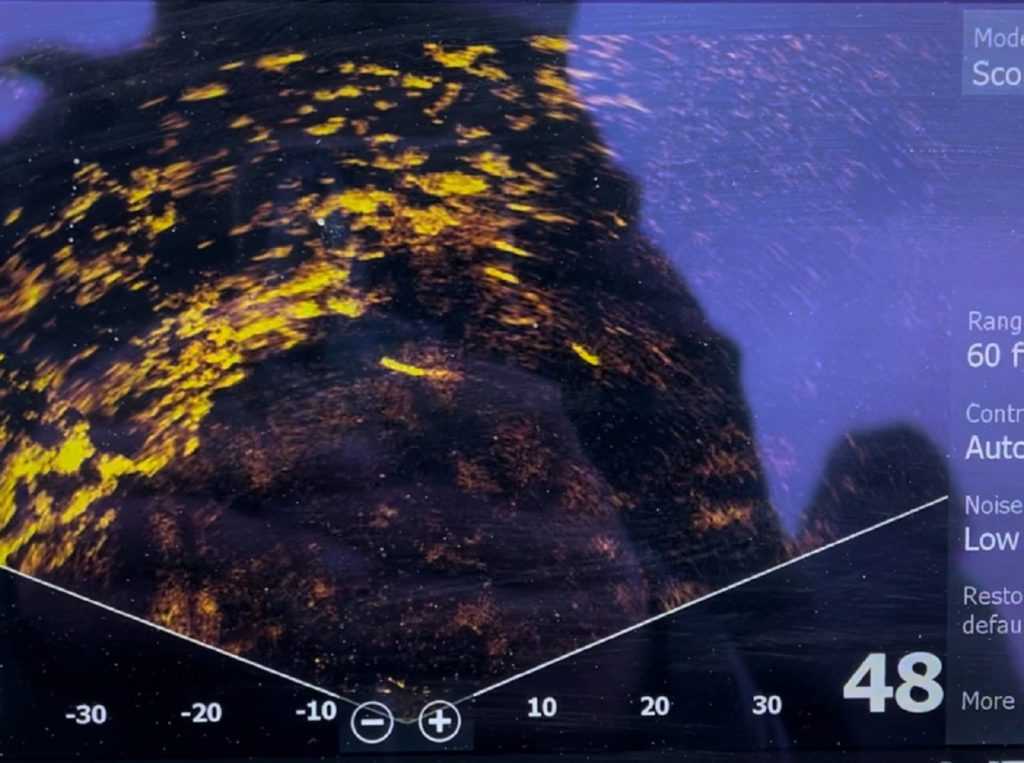
And it has made mobility, electronics and depth control increasingly valuable.
How to Fish Pyramid Lake Nevada
There are several effective ways to fish Pyramid Lake.
The primary methods include:
- Fly fishing
- Jigging with spinning tackle
- Trolling
- Shore and ladder fishing
- Boat fishing
Each technique has advantages depending on season, fish location, water temperature and depth.
There isn’t one method that works everywhere all season.
The key is matching your fishing technique to what the trout are doing.
How to Fly Fish Pyramid Lake
Fly fishing is one of the most established and effective ways to catch Lahontan Cutthroat Trout at Pyramid Lake.
But there isn’t one way to fly fish the lake.
We generally think about Pyramid Lake fly fishing in three broad categories:
Indicator fishing.
Retrieve fishing.
Deep-water fly fishing.
Indicator Fishing Pyramid Lake

Indicator fishing allows anglers to suspend flies at a controlled depth and keep them in the feeding zone.
Common patterns include:
- Balanced leeches
- Midges
- Chironomids
The key is often depth rather than simply fly selection.
If Lahontan Cutthroat are feeding at 12 feet and your flies are sitting at 6 feet, even the perfect fly may never get eaten.
Leader length and weight are adjusted to keep the flies at the appropriate depth.
Indicator fishing can be particularly effective during the colder months and whenever trout are holding in predictable zones.
Retrieve Fly Fishing

Retrieve fishing targets the predatory nature of Lahontan Cutthroat Trout.
Beetles, streamers, Midnight Cowboy-style patterns and baitfish imitations are cast and retrieved through the water column.
Several variables matter:
- Retrieve speed
- Fly profile
- Depth
- Sinking rate
- Direction
- Fish activity
Sometimes the fish want speed.
Sometimes they respond to a slower presentation.
Sometimes changing the depth by only a few feet can completely change the fishing.
A 9-foot 8-weight fly rod paired with the appropriate intermediate or sinking line is an excellent setup for retrieve fishing.
Deep-Water Fly Fishing Pyramid Lake
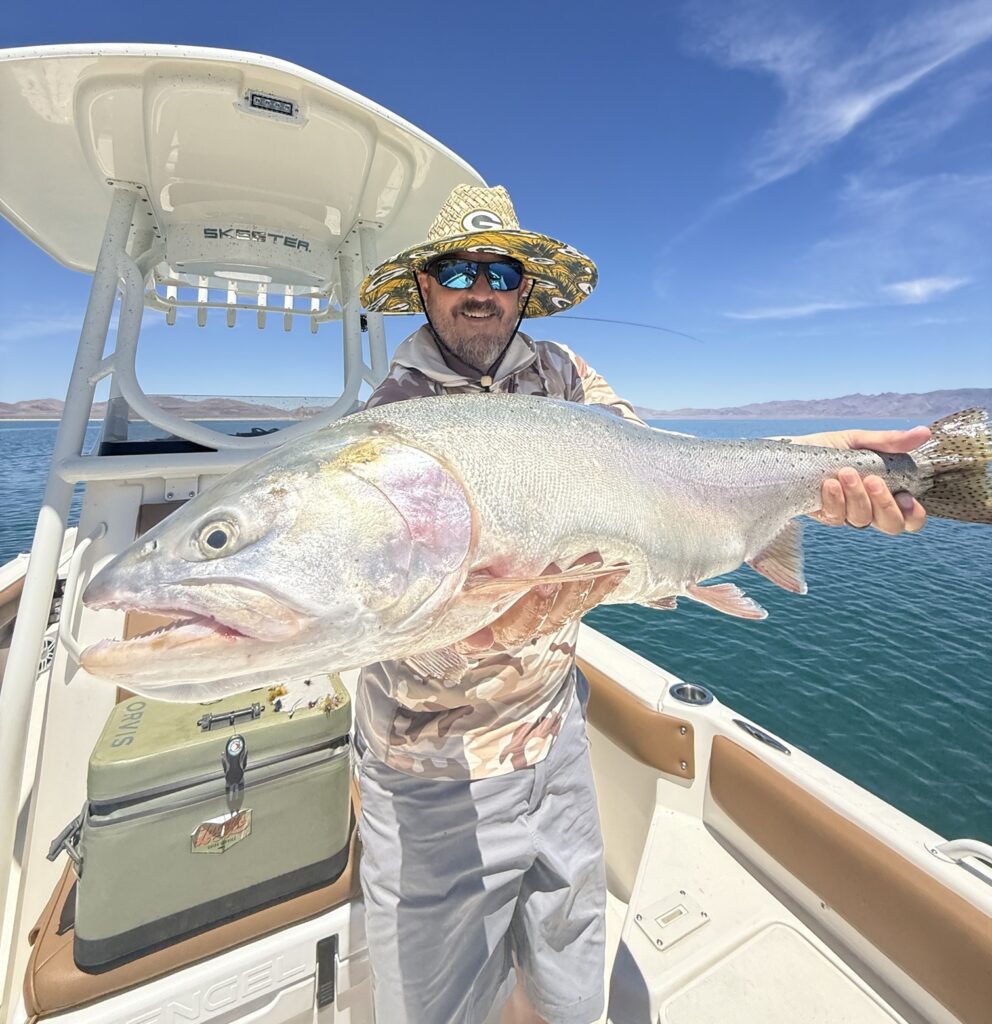
Deep-water fly fishing has become an increasingly important part of modern Pyramid Lake fishing.
When Lahontan Cutthroat are holding at 20, 40, 60 feet—or even deeper—we need a way to put flies into that water.
This is where a boat and electronics completely change what is possible.
We can locate bait.
We can locate trout.
We can determine their depth.
Then we can place our flies into the strike zone.
The Dangle
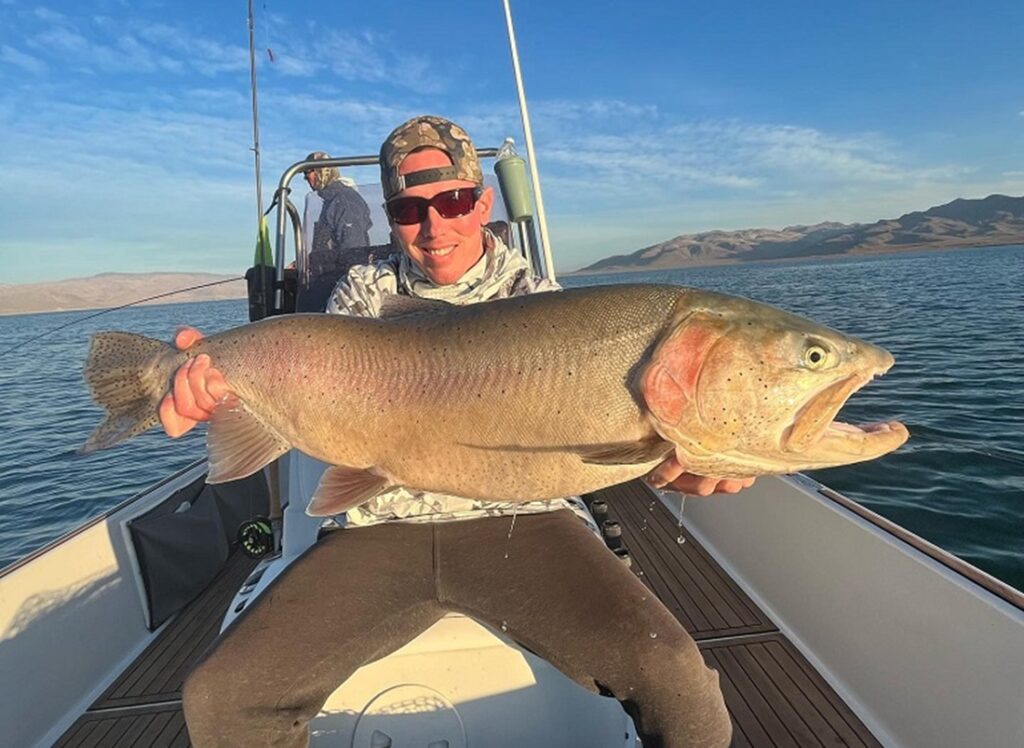
One of the techniques we use in deep water is the Dangle.
Rather than making a traditional long cast and retrieve, flies are presented vertically or nearly vertically beneath the boat at a controlled depth.
An 11-foot 7-weight switch/Spey-style rod provides excellent line control for this technique.
The objective is simple:
Find the fish. Determine their depth. Put the flies in front of them.
Best Flies for Pyramid Lake
Pyramid Lake has developed its own collection of fly patterns over decades of targeting Lahontan Cutthroat Trout. Some imitate the lake’s natural forage, while others are attractor patterns designed simply to get the attention of a cruising trout. The best fly depends on the season, depth and technique being used, but Balanced Leeches, midges, streamers and foam beetles account for a tremendous number of Pyramid Lake fish every season.

Balanced Leeches
The Balanced Leech has become one of the most important flies at Pyramid Lake, particularly when fishing beneath an indicator or using our deep-water Dangle technique from a boat. Unlike a conventional leech pattern, the fly is tied so that it hangs horizontally in the water, giving it a natural swimming profile even when very little movement is added.
Black, purple and olive are excellent starting colors, along with combinations incorporating contrasting or flashy materials. Balanced Leeches can be especially effective when Lahontan Cutthroat are feeding on Tui chub and other larger forage. From the boat, the ability to suspend these flies at the exact depth where fish are showing on the electronics makes them particularly effective.
Midges
Midges are a major food source at Pyramid Lake and are responsible for countless trout caught beneath indicators. Zebra Midges, Tiger Midges, Snow Cones, Maholo Midges, Albino Winos and similar chironomid patterns are all proven choices.
Midges are generally fished beneath an indicator, often as part of a two-fly rig. The goal is to position the bottom fly just above the lake bottom or suspend the flies at the depth where trout are cruising. Black, red, wine, copper and combinations of these colors are all productive.
Don’t underestimate these small flies. Pyramid Lake may contain trout exceeding 20 pounds, but some of its largest fish are perfectly willing to eat a tiny midge.
Midnight Cowboy
The Midnight Cowboy is one of Pyramid Lake’s classic stripping flies. Its dark profile and contrasting flash make it easy for trout to locate, particularly when retrieved along the bottom with a sinking or shooting-head line.
The Midnight Cowboy is frequently paired with a foam beetle or another contrasting fly on a two-fly retrieve rig. Retrieve speed can vary dramatically throughout the season. During colder water conditions a slower retrieve may work best, while warmer spring and fall conditions can produce aggressive strikes on a much faster retrieve.
Popcorn Beetle
The Popcorn Beetle is another classic Pyramid Lake pattern and one of the flies most closely associated with the traditional retrieve technique. Its buoyant foam body allows the fly to rise when the retrieve pauses and then dive again as the line is stripped.
That rise-and-fall action is exactly what makes the beetle so effective. When paired with a heavier streamer such as a Midnight Cowboy, the two flies create very different profiles and movements during the retrieve. Trout will often follow these flies for a considerable distance before committing, which is why the retrieve should continue all the way back toward the boat or angler.
Woolly Buggers, Clousers and Other Streamers
Traditional Woolly Buggers remain productive at Pyramid Lake, particularly in black, purple, olive, green and chartreuse. Clouser Minnows and other baitfish-style streamers can also be effective when Lahontan Cutthroat are actively feeding on Tui chub.
These larger patterns are particularly useful when covering water with the retrieve technique. The objective is generally to keep the flies close to the bottom while varying retrieve speed until the trout tell you what they want.
Choosing the Right Pyramid Lake Fly
There really isn’t one “best” fly for Pyramid Lake. Depth, presentation and location are often more important than the exact pattern. A perfectly chosen fly presented ten feet above the fish may never get touched, while a basic Balanced Leech or midge placed directly in the strike zone can be deadly.
This is one of the major advantages of fishing Pyramid Lake from a boat. Electronics allow us to determine where the trout are holding and then choose the fly, leader length and technique needed to put that fly directly in front of them. Whether we’re fishing Balanced Leeches and midges beneath an indicator, working flies vertically with the Dangle technique, or rapidly retrieving a Midnight Cowboy and Popcorn Beetle, the objective is always the same—put the right fly at the right depth and keep it there long enough for a Lahontan Cutthroat to find it.
How to Spin Fish Pyramid Lake – Jig Fishing

Fly fishing isn’t the only effective way to catch Lahontan Cutthroat Trout.
Jig fishing can be extremely effective, particularly from a boat when fish are holding in deeper water.
Modern electronics make this approach much more precise.
A basic approach is:
- Locate trout or concentrations of Tui Chub with electronics.
- Determine the depth where the trout are holding.
- Drop the jig to that depth.
- Work the jig vertically with controlled movement.
- Adjust depth as the fish move.
Jigging can be particularly effective when Lahontan Cutthroat are relating to bait or deeper structure.
The same rule applies here that applies to deep-water fly fishing:
You can’t catch fish at 50 feet if your presentation is at 20 feet.
Depth control matters.
Always check current Pyramid Lake Paiute Tribe regulations regarding permitted tackle, hooks and fishing methods.
What Jigs and Lures Work Best at Pyramid Lake?

Fly fishing may get much of the attention at Pyramid Lake, but conventional tackle can be extremely effective for Lahontan Cutthroat Trout. Jigging, casting spoons and trolling minnow-style lures all have a long history of producing fish here. The key is matching the presentation to the depth of the trout.
When fish are concentrated in deeper water, especially when located with electronics from a boat, vertical jigging can be one of the most effective ways to put a lure directly in front of them. When trout are cruising shelves and drop-offs closer to shore, casting and retrieving spoons or other swimming lures allows an angler to cover considerably more water.
Jigging for Lahontan Cutthroat Trout
Fly fishing may get much of the attention at Pyramid Lake, but conventional tackle can be extremely effective for Lahontan Cutthroat Trout. Jigging, casting spoons and trolling minnow-style lures all have a long history of producing fish here. The key is matching the presentation to the depth of the trout.
When fish are concentrated in deeper water, especially when located with electronics from a boat, vertical jigging can be one of the most effective ways to put a lure directly in front of them.
When trout are cruising shelves and drop-offs closer to shore, casting and retrieving spoons or other swimming lures allows an angler to cover considerably more water.
Marabou jigs are one of the proven conventional presentations at Pyramid Lake. Black and purple have traditionally been productive colors, with 1/8- to 1/4-ounce jigs providing a good starting point. From a boat, use your electronics to locate trout or baitfish, drop the jig to the depth where the fish are holding, and work it vertically with short lifts followed by controlled drops. Don’t overlook the fall—a Lahontan Cutthroat will often take a jig as it drops.
Jigging becomes particularly valuable when trout are holding deep and concentrated around bait. Rather than continually covering water, the boat can remain over productive structure or fish located on the electronics and keep the jig in the strike zone.
Casting Spoons and Other Lures
When trout are cruising shallower shelves and drop-offs, spoons and minnow-imitating lures can be excellent choices. Cast beyond the drop-off, allow the lure to sink to the desired depth and retrieve it steadily, occasionally adding a twitch or brief pause. The flash and movement imitate the baitfish that large Lahontan Cutthroat actively hunt.
From a boat, trolling is another proven Pyramid Lake technique. Flatfish, Apex-style lures and other minnow imitations have been used successfully for decades. The advantage of trolling is the ability to cover large areas of the lake while keeping the lure at a controlled depth—particularly useful when trout are scattered rather than concentrated in one location.
Regardless of technique, Pyramid Lake regulations prohibit bait and require artificial lures and barbless hooks, so anglers should always check the current Pyramid Lake Paiute Tribe regulations before fishing.
How to Troll Pyramid Lake
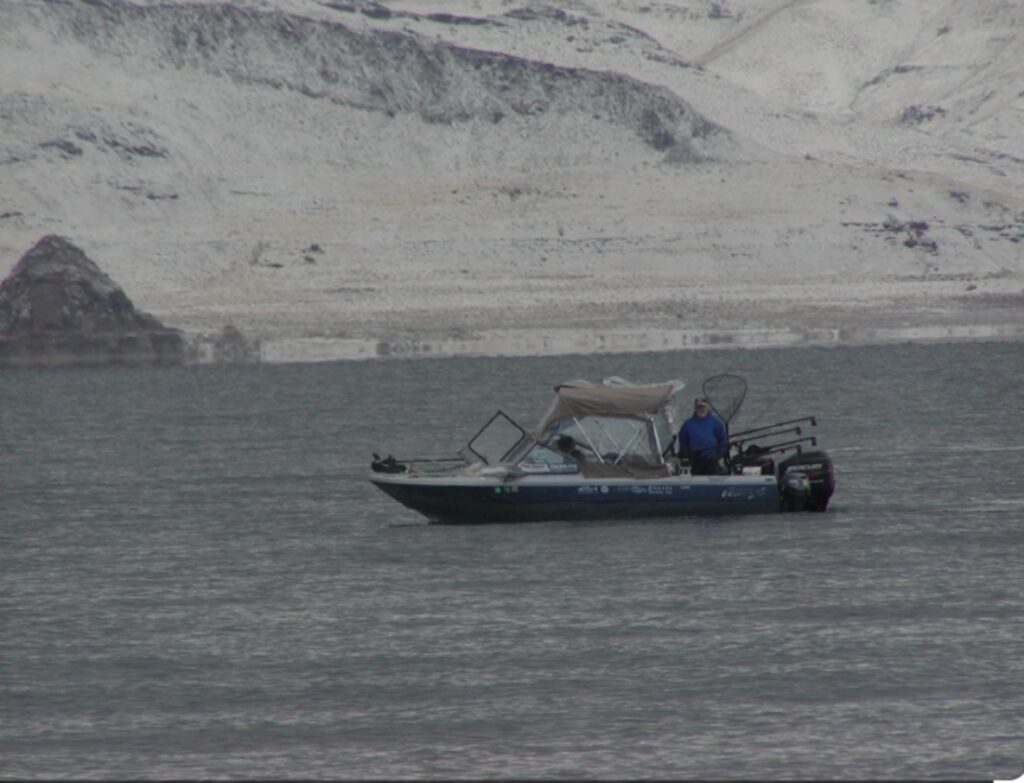
Trolling is another proven method for catching Lahontan Cutthroat Trout at Pyramid Lake.
Its biggest advantage is the ability to cover water.
On a lake approximately 27 miles long and covering more than 100,000 acres, that’s important.
Spoons, plugs and other permitted artificial lures can be trolled at different speeds and depths.
The primary variables are:
- Depth
- Speed
- Location
- Lure profile
- Water temperature
- Proximity to bait
Electronics can make trolling considerably more precise.
If trout consistently appear at a particular depth, the objective is to get the trolling presentation into that zone and keep it there.
Good trolling isn’t simply dragging something behind the boat.
It’s controlled fishing where speed, depth and location work together.
Trolling at Pyramid Lake

Trolling is one of the most effective ways to cover water and locate active Lahontan Cutthroat Trout, especially when fish are spread out across drop-offs and deep points. By presenting lures at a consistent depth and speed, you can trigger strikes from aggressive trout that are chasing baitfish.
Best Lures for Trolling
Trolling minnow-imitating lures has been a proven technique on Pyramid Lake for decades. Productive choices include Flatfish, Apex-style lures, and other quality stickbaits and minnow-pattern plugs that imitate the lake’s baitfish.
Productive colors include chrome/blue, chrome/black, chartreuse, olive, purple, and natural baitfish patterns such as silver/black. Lure size can also make a difference, so don’t be afraid to change both the size and profile of the lure until you determine what the trout are responding to that day.
Trolling Depth and Speed
The real key to successful trolling at Pyramid Lake is getting your lure into the same part of the water column where the trout are holding. Electronics can be extremely valuable for locating fish and identifying productive depths. Depending on the season and location, trout may be cruising relatively shallow or suspended considerably deeper.
Downriggers, lead-core line, or other weighted trolling systems can help maintain a consistent presentation at the desired depth. Once fish are located, experiment with both trolling speed and lure depth until a pattern develops. Even relatively small changes in speed, direction, or depth can trigger a following Lahontan Cutthroat to strike.
From a boat, trolling offers one major advantage: you can efficiently search a tremendous amount of water while keeping your lure in the strike zone. When trout are scattered rather than concentrated in one area, it can be one of the most productive ways to find active fish at Pyramid Lake.
Shore and Ladder Fishing Pyramid Lake

You can’t talk about fishing Pyramid Lake without talking about ladders.
Ladder fishing is one of the lake’s great traditions.
Anglers position ladders offshore, giving themselves elevation above the water and allowing them to target trout cruising along shoreline drop-offs.
During periods when Lahontan Cutthroat move shallow, ladder fishing can be extremely productive.
Both indicator and retrieve techniques can be used from shore.
The limitation is straightforward:
The fish ultimately have to come within casting range.
If trout move deeper or follow bait offshore, the shore angler either relocates or waits for fish to return.
There are times of year when that doesn’t matter because the fish are shallow.
And spring remains one of those important periods.

Shore and Ladder Fishing Access - Limited
Shore and ladder anglers at Pyramid Lake are largely limited to the western side of the lake, where the Pyramid Lake Paiute Tribe provides access to the established fishing beaches. This is where nearly all of Pyramid Lake’s famous ladder fishing takes place, with anglers wading out to the edge of the shallow shelves and positioning their ladders near the drop-offs where Lahontan Cutthroat Trout cruise.
The other areas of the Lake also have portions of the lake with restrictions and closed areas, so anglers should always check the current Tribal regulations and open-beach map before choosing where to fish.
It is important to note that Boat Anglers have access to approximately 80% of the Lake’s fishing areas compared to the limited access available to shore fisherman.
Best Time to Fly Fish Pyramid Lake
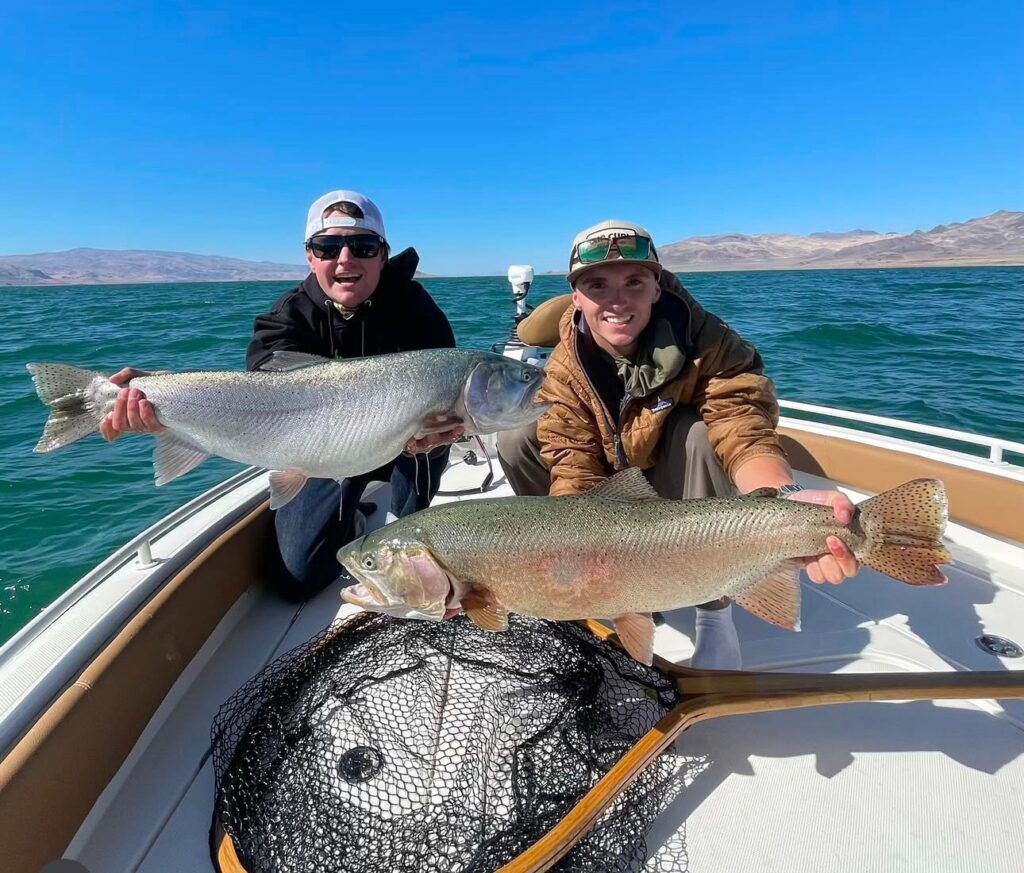
One of the most common questions anglers ask is:
When is the best time to fly fish Pyramid Lake?
The answer has changed.
For decades, the traditional answer was:
March, April and into May.
There was a very good reason for that.
During the years when Summit Lake strain Lahontan Cutthroat dominated Pyramid Lake, enormous numbers of those fish moved into shallow water during the spawning period.
They could remain within reach of shore anglers for extended periods.
That created some of the most predictable fishing of the season and helped make Pyramid Lake ladder fishing famous.
But there is an important distinction:
Much of that legendary spring fishing was driven by the Summit strain.
Today’s fishery contains a much larger component of Pilot Peak Lahontan Cutthroat, and Pilot Peaks don’t necessarily behave the same way.
They’re more predatory.
They spend more time following Tui Chub.
They utilize more of the lake.
And they don’t always remain concentrated in shallow water for the same extended periods that historically made March and April so predictable.
That has changed our definition of the best time to fly fish Pyramid Lake.
March, April and May – The Traditional Spring Shore Fishery
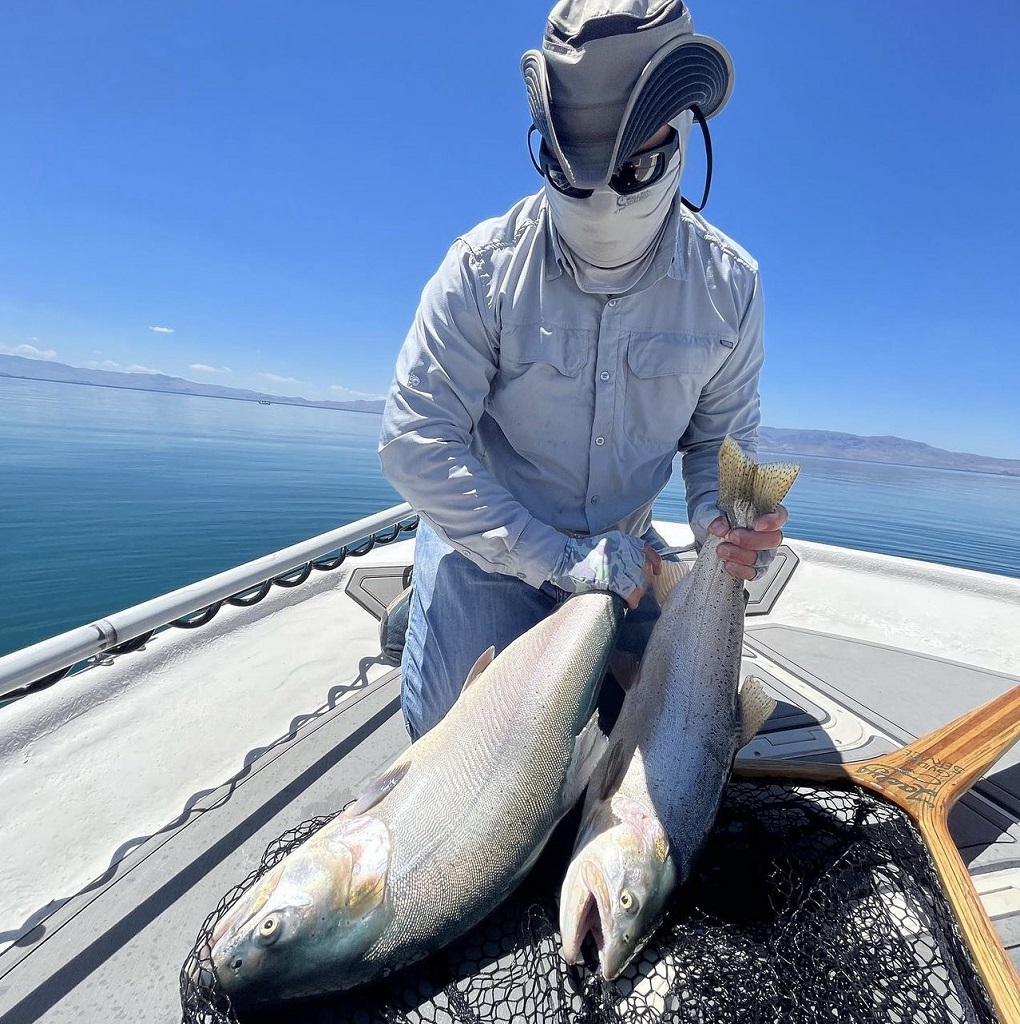
Let’s make one thing clear:
Spring shore fishing at Pyramid Lake can still be extremely productive.
The fact that the fishery has changed doesn’t mean the spring bite disappeared.
March, April and portions of May can still provide excellent fly fishing as Lahontan Cutthroat move shallow in association with spawning activity.
When trout concentrate along beaches and drop-offs, traditional Pyramid Lake techniques can be extremely effective:
- Indicator fishing
- Balanced leeches
- Midges and chironomids
- Retrieve fishing
- Beetles and streamers
- Ladder fishing
The difference is that spring is no longer the only window we consider prime.
Our Boats Can Access the Shore Bite Too
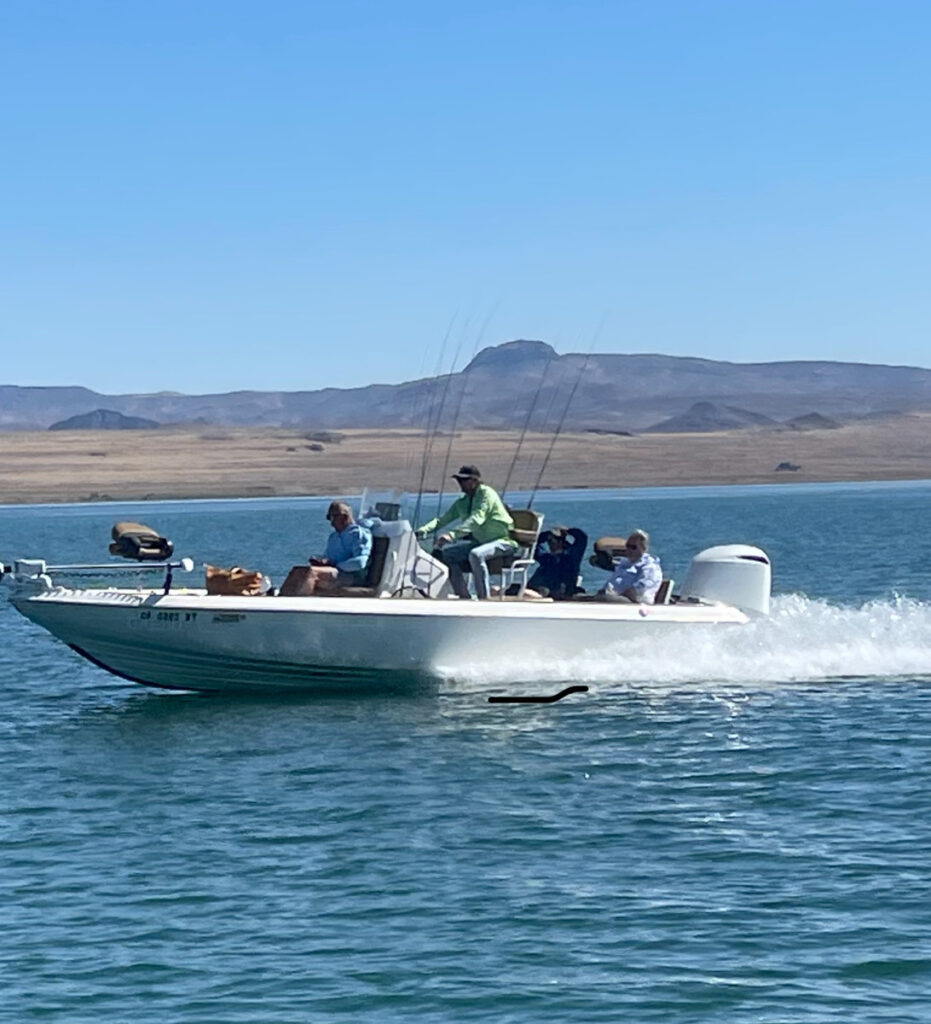
This is an important distinction about the way we fish Pyramid Lake.
Fishing from a boat does not mean we spend the entire day sitting offshore in deep water.
If the best fishing is along the shoreline, that’s where we want to be.
We can use our boats to access productive beaches, drop-offs and shallow-water areas and fish the same spring conditions that make shore fishing so effective.
If the trout move offshore, we move offshore.
If they move deeper, we can change techniques.
If they return shallow, we can return shallow.
We don’t think about it as:
Shore fishing versus boat fishing.
We think about it as:
Where are the fish today?
The boat is simply the tool that allows us to reach more of the lake.
We don’t use the boat because we always want to fish deep. We use the boat because it allows us to fish where the fish are.
October and November – Fall Fly Fishing
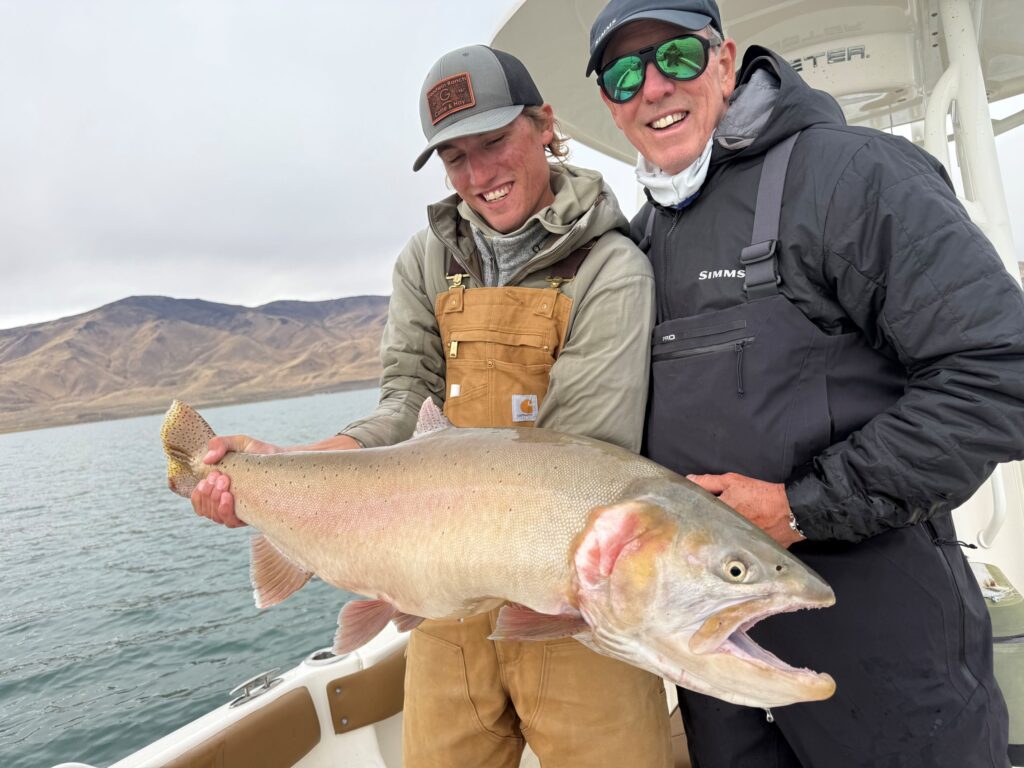
October begins a new Pyramid Lake fishing season and is one of the periods we look forward to most.
Trout are transitioning from their summer patterns.
Tui Chub remain an important food source.
And Lahontan Cutthroat can feed aggressively as conditions change.
For today’s Pilot Peak-oriented fishery, October can provide outstanding opportunities.
It is no longer accurate to assume anglers need to wait until spring to experience prime Pyramid Lake fly fishing.
December Through February – Winter Fly Fishing
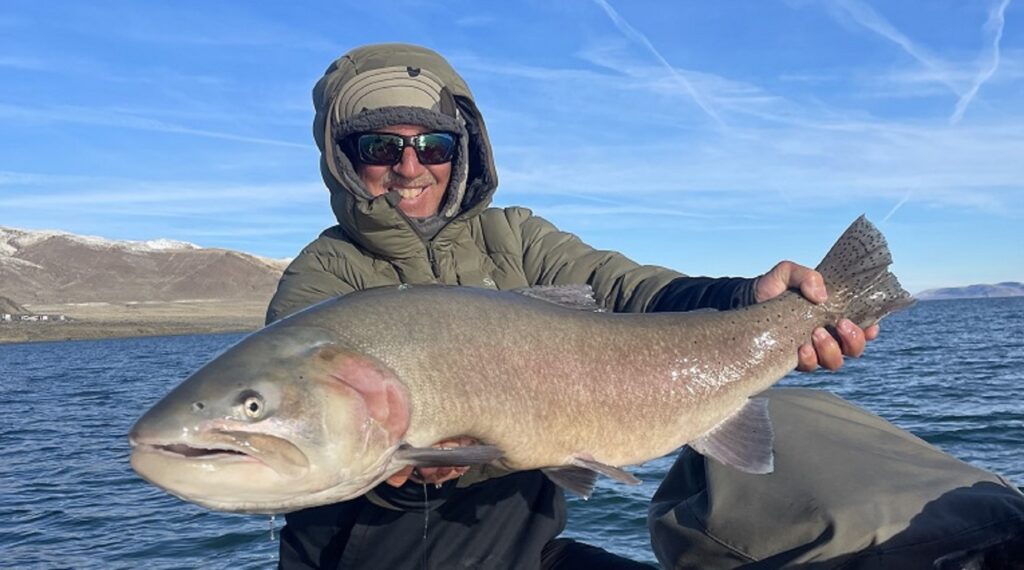
As water temperatures fall, Lahontan Cutthroat change location and behavior.
Indicator fishing becomes increasingly important, and balanced leeches, midges and other suspended presentations can be extremely effective.
Winter can provide very consistent fishing. It can also produce enormous trout.
A 29-pound Lahontan Cutthroat Trout landed on a Lacey’s Guide Service trip in January 2025 demonstrates the trophy potential of the winter fishery.
January 2026 Pyramid Lake Fishing Report / February 2026 Pyramid Lake Fishing Report
May and June – Follow the Fish Deeper
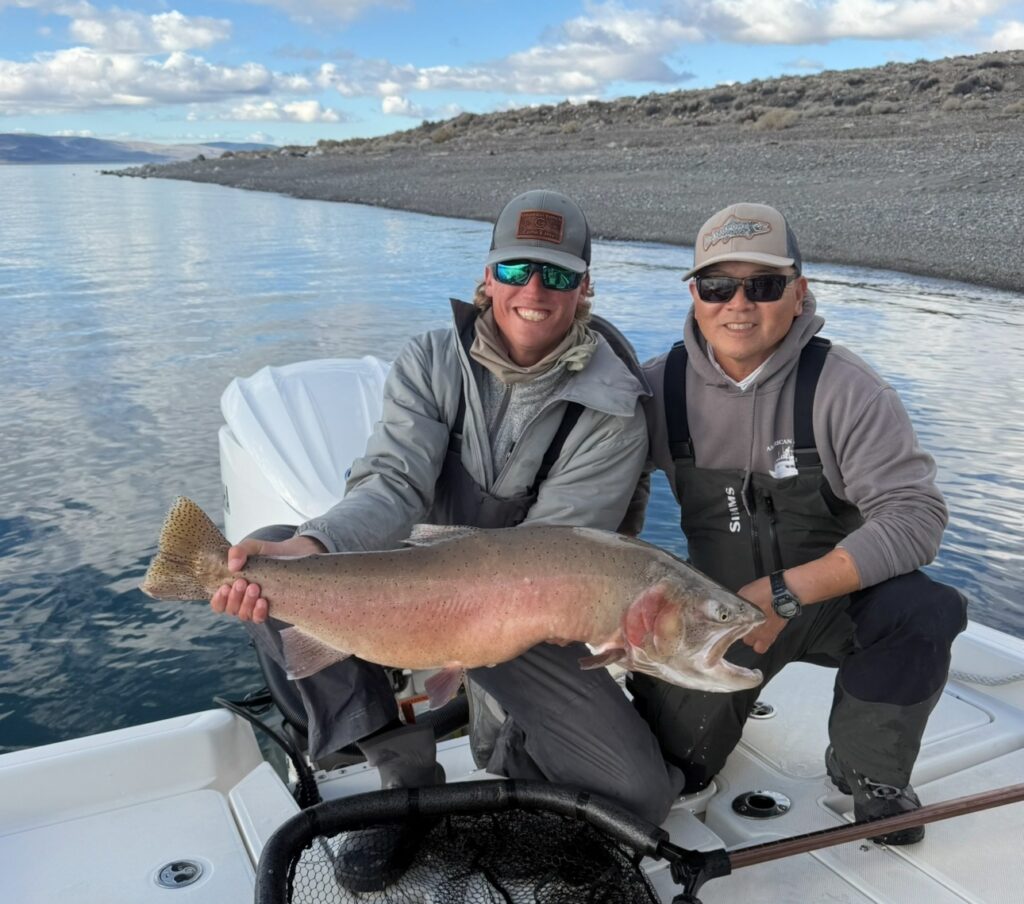
As the spawn winds down and surface water begins warming, another important transition occurs.
The Tui Chub move.
The trout move.
And much of the fishing can begin shifting away from traditional shallow-water areas.
This is when boat-based fly fishing becomes especially powerful.
We can use electronics to locate bait and Lahontan Cutthroat, determine the depth where they’re holding and adjust our presentation.
Indicator fishing can work.
Retrieve fishing can work.
And deep-water techniques such as the Dangle become increasingly important.
June has become one of the months we most look forward to.
June 2026 produced more than 100 guided trips and over 25 Lahontan Cutthroat Trout weighing 20 pounds or more—including one angler who caught three 20-pounders.
Twenty years ago, many Pyramid Lake anglers would have considered June well past the traditional prime spring season.
Today, it can be one of the most exciting trophy periods of the year.
So When Is the Best Time to Fish Pyramid Lake?
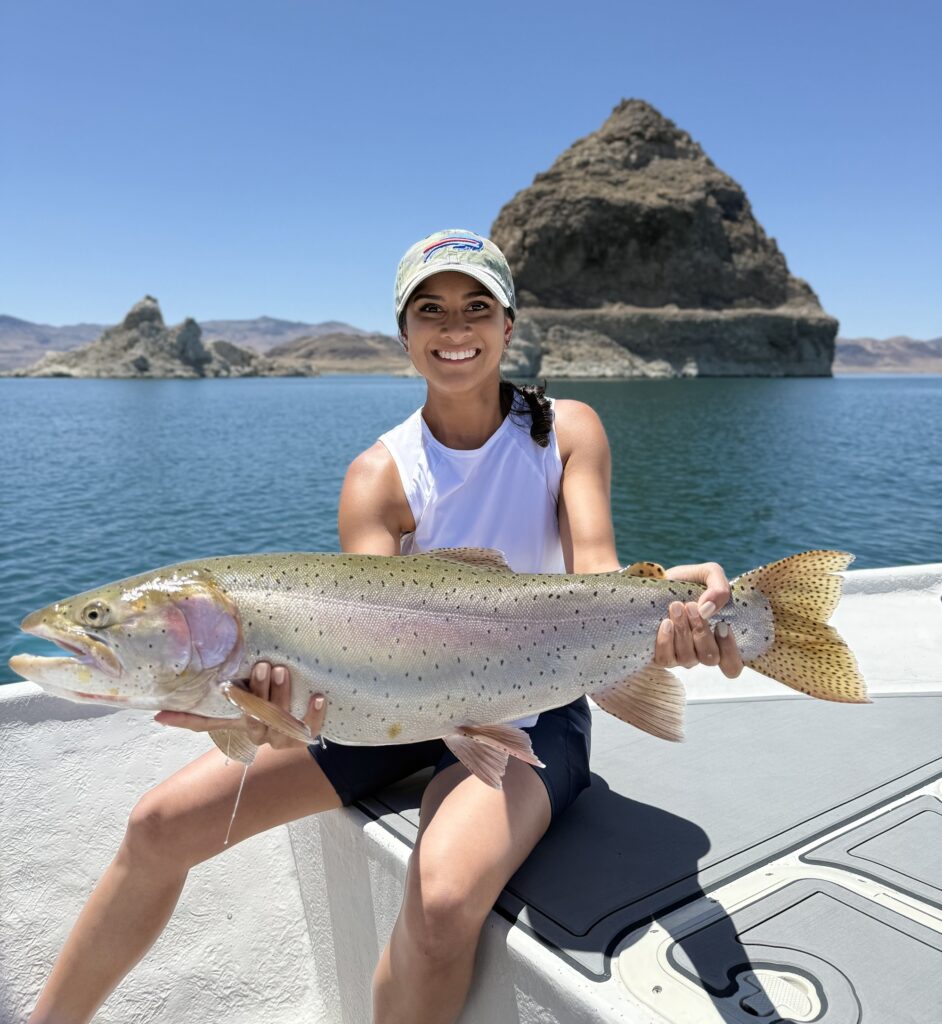
There isn’t one answer anymore.
That’s one of the most important lessons of the modern fishery.
If your priority is traditional shallow-water fishing associated with the spawn, March through May can still be excellent.
If you’re interested in the changing Pilot Peak fishery, bait-oriented trout and the opportunity to target fish throughout the lake, October and the late May–June period have become extremely important windows.
Winter can provide excellent indicator fishing and tremendous trophy potential.
So we no longer build the Pyramid Lake calendar around a single “best month.”
We build it around the fish.
October through June offers different opportunities—and successful fishing comes from changing with the Lahontan Cutthroat as they move throughout the season.
Dark, high-contrast retrieve patterns have been catching Pyramid Lake trout for years and remain productive under the right conditions.
The question shouldn’t simply be:
“What fly are they eating?”
It should be:
“Where are the fish, what are they feeding on, and how do we put the fly in front of them?”
Why Fish Pyramid Lake From a Boat?
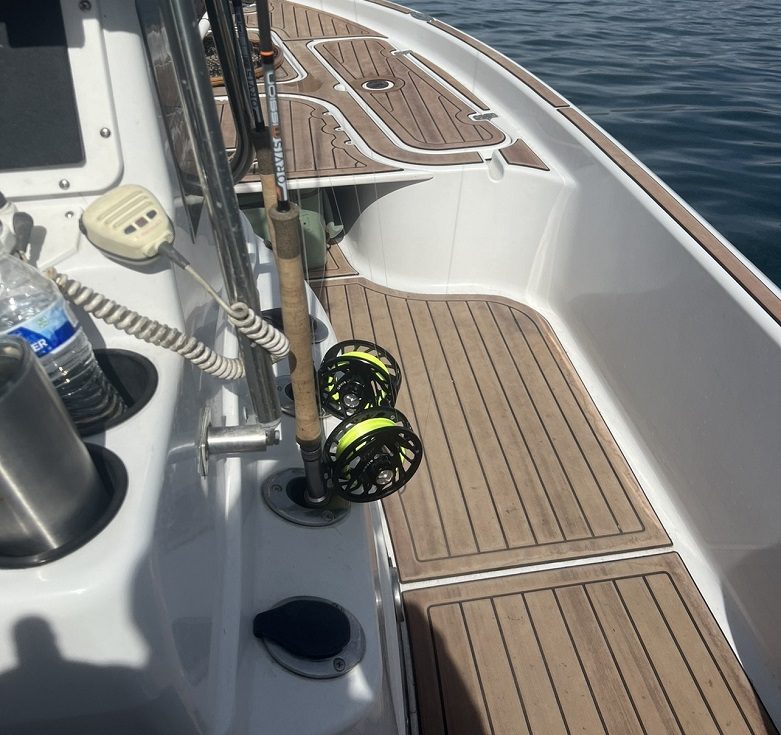
A boat changes the fundamental equation.
A shore angler ultimately needs the fish to come within casting range.
A boat allows us to go looking for the fish.
That becomes enormously valuable on a lake covering approximately 112,000 acres.
If the fish move, we can move.
If the bait moves, we can follow it.
If the fish change depth, we can change our presentation.
And importantly:
If the fish are shallow, we can fish shallow too.
Boat fishing doesn’t eliminate the shore bite.
It gives us another way to access it.
Electronics Have Changed Pyramid Lake Fishing
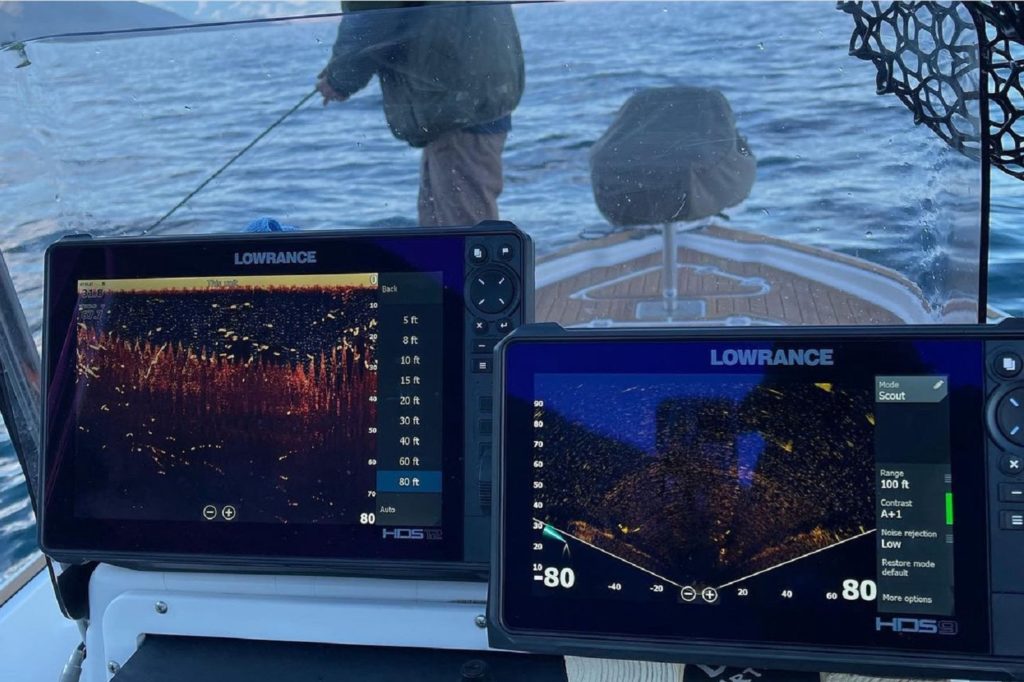
Modern electronics have become an important tool in understanding what’s happening beneath the boat.
They allow us to:
- Locate Tui Chub and other bait
- Identify trout
- Find structure
- Determine depth
- See where fish are positioned in the water column
- Adjust presentations accordingly
Electronics don’t catch the fish. But they can help answer the first question every angler needs answered:
Are we fishing where the fish are?
Why We Prefer Fly Fishing Pyramid Lake From a Boat
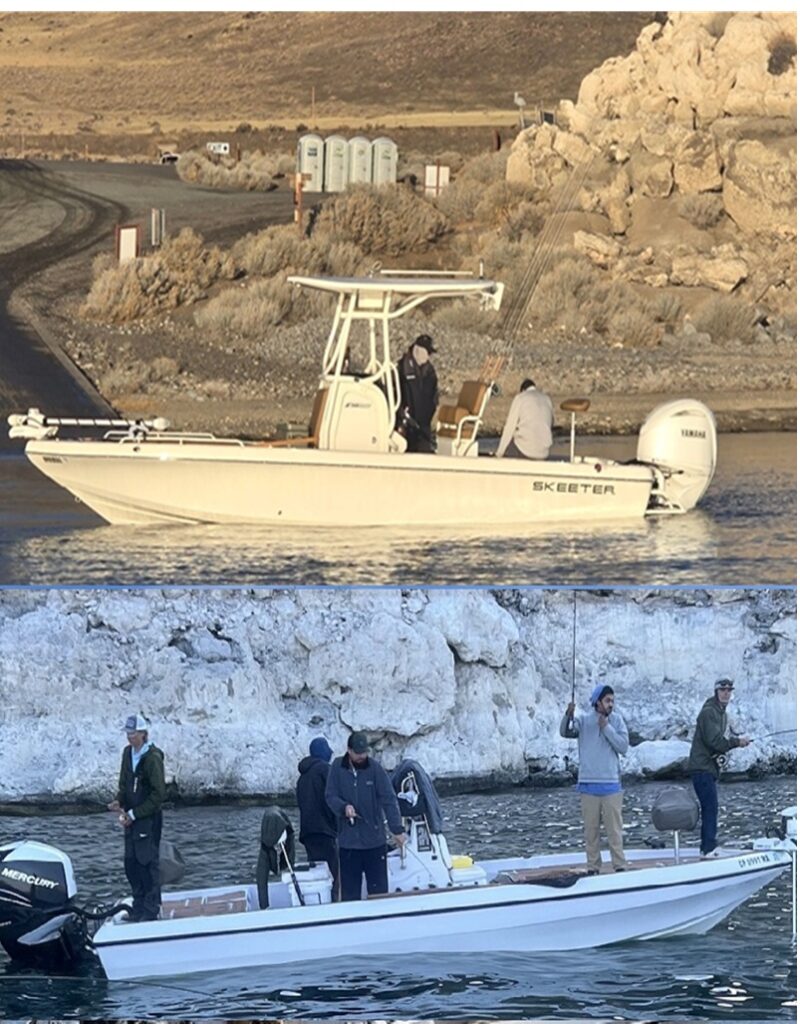
Jigging works. Trolling works. Shore fishing works. Ladder fishing works. We’re not going to tell anglers otherwise.
But after years of fishing Pyramid Lake, we believe fly fishing from a boat offers an exceptional combination of mobility, depth control, versatility and experience.
And today’s Pilot Peak-oriented trophy fishery makes those advantages increasingly important.
We Can Go to the Fish
We’re not limited to casting distance from one section of shoreline.
If the fish move, we can search for them.
On a lake 27 miles long, that’s a major advantage.
We Can Follow the Bait
Pilot Peak Lahontan Cutthroat are highly predatory.
Tui Chub are an important food source.
When the bait moves, the trout can move with it.
A boat and electronics give us the ability to search for both.

We Can Fish the Shoreline
This is an advantage that is sometimes overlooked.
A boat isn’t only a deep-water platform.
When the spring bite develops along a beach or shallow drop-off, we can use the boat to access that water.
We’re not forced to choose between shallow and deep.
We fish whichever is producing.
We Can Fish the Entire Water Column
This may be the greatest advantage.
If the trout are shallow:
Retrieve.
If they’re suspended:
Indicator.
If they’re deep:
Dangle.
We’re not committed to one depth or one presentation.
We can change with the fish.
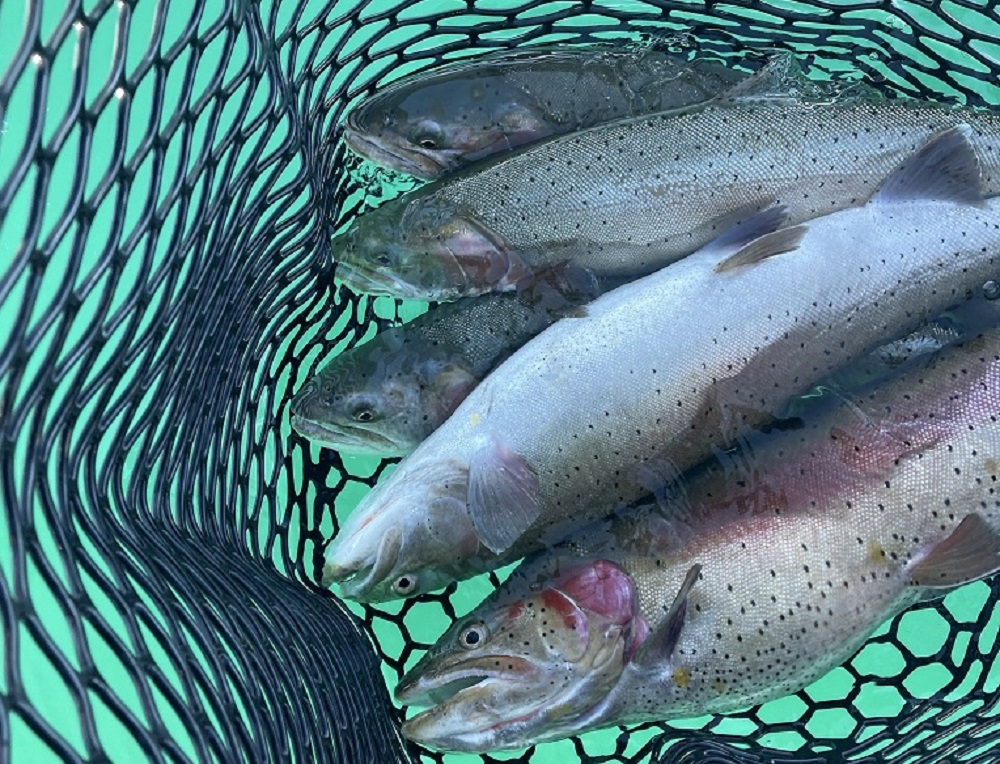
Fly Fishing Gives Us Multiple Presentations
We can imitate tiny aquatic insects.
We can fish balanced leeches.
We can retrieve beetles and streamers.
We can imitate Tui Chub.
We can present flies vertically in deep water.
The same basic approach allows us to target Lahontan Cutthroat in completely different ways as conditions change.
Then There's the Fight
There’s also something that doesn’t show up on a fish finder.
Hooking a giant Pilot Peak Lahontan Cutthroat on a fly rod is simply different.
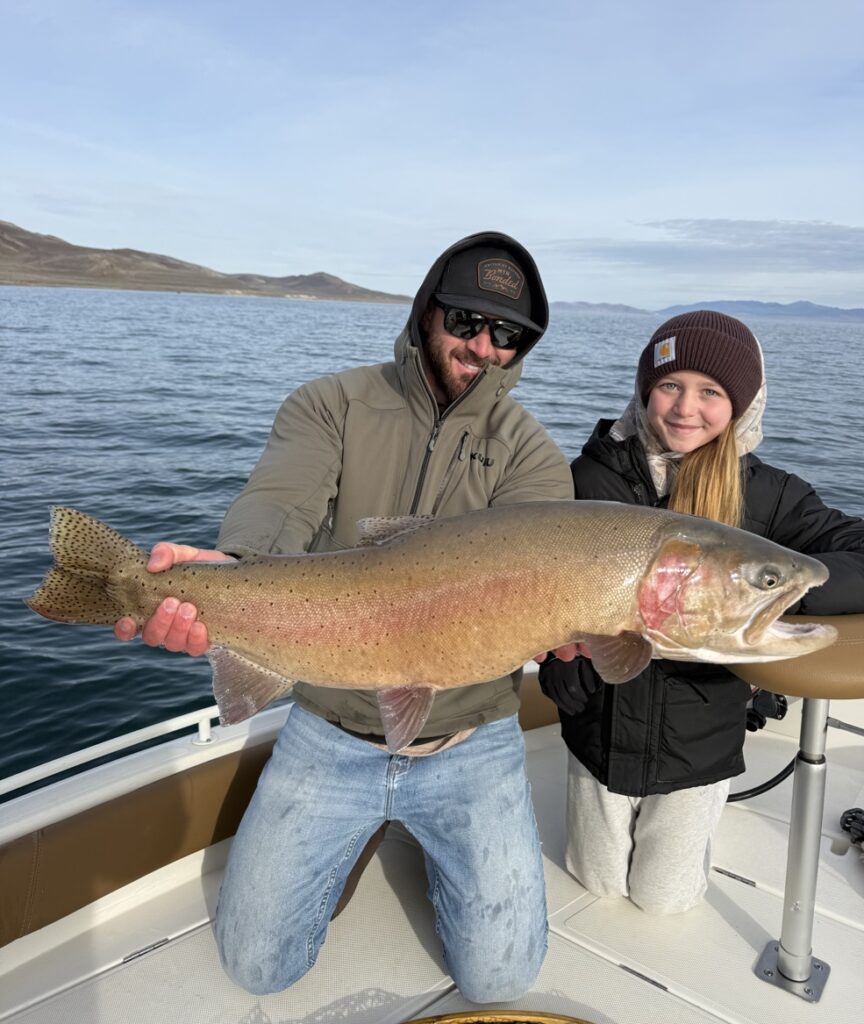
When a 15- or 20-pound trout eats the fly and starts taking line, you’re connected directly to one of the largest cutthroat trout on earth.
That’s a big part of why we fly fish Pyramid Lake.
Fly Rods, Lines and Tackle for Pyramid Lake

Pyramid Lake isn’t a place for light trout tackle.
These fish are powerful.
The lake is enormous.
And the next trout that eats your fly could weigh 20 pounds.
Retrieve Setup
A 9-foot 8-weight fly rod is an excellent choice for retrieve fishing.
Pair it with a quality reel with a strong, smooth drag and an intermediate or sinking line appropriate for the depth being fished.
Indicator and Dangle Setup
For indicator and deep-water Dangle fishing, we commonly use an 11-foot 7-weight switch/Spey-style rod.
The additional length provides excellent line control and leverage and works particularly well with long leaders and deep presentations.
Leader length, weight and fly placement are adjusted according to conditions and depth.
Strong tippet, good knots and a properly adjusted drag matter when you’re fishing for trout this large.
Do You Need a Guide to Fish Pyramid Lake?

No.
Anglers successfully fish Pyramid Lake on their own every season.
But Pyramid Lake can be challenging—even for experienced fishermen.
You’re trying to locate trout in approximately 112,000 acres of water, and bait, fish location, depth and weather can change quickly.
Local knowledge can dramatically shorten the learning curve.
A knowledgeable Pyramid Lake guide helps determine:
- Where trout have been holding
- Where Tui Chub are located
- Productive depths
- Current fly patterns
- Indicator versus retrieve tactics
- Deep-water presentations
- Productive shoreline areas
- How weather affects fish movement
- How conditions have changed from previous days
Lacey’s Guide Service specializes in boat-based fly fishing for Pyramid Lake’s Lahontan Cutthroat Trout.
Our guided trips include professional equipment and experienced USCG-licensed captains.
Our boats use modern electronics to help locate bait, fish and productive water.
And with multiple boats fishing the lake, our guides can communicate throughout the day as conditions change.
The goal is simple:
Find active fish and put our anglers in the best possible position to catch them.
Current Pyramid Lake Fishing Conditions
Pyramid Lake changes throughout the season.
Water temperature, weather, bait location and fish movement can all affect where and how we fish.
That’s why current information matters.
For recent catches, conditions, productive depths and techniques, visit our: Pyramid Lake Fishing Report
Our fishing reports provide firsthand information from guides actually fishing Pyramid Lake throughout the season.
They also allow anglers to compare current conditions with previous months and seasons.

Fishing Pyramid Lake Today – The Giants Are Back
The story of Pyramid Lake has almost come full circle.
More than a century ago, giant Lahontan Cutthroat Trout exceeding 40 pounds swam these waters and migrated between Pyramid Lake and the Truckee River.
Commercial fishing removed enormous numbers of trout.
Water diversion and Derby Dam disrupted their spawning migration.
Habitat changed.
Eventually, the original Pyramid Lake trout disappeared.
The lake was rebuilt with other Lahontan Cutthroat strains.
For years, Pyramid became an extraordinary numbers fishery.
Then the Pilot Peak strain returned.
And the lake began changing again.
Today we’re catching 20-pound trout. We’ve landed a 29-pounder.
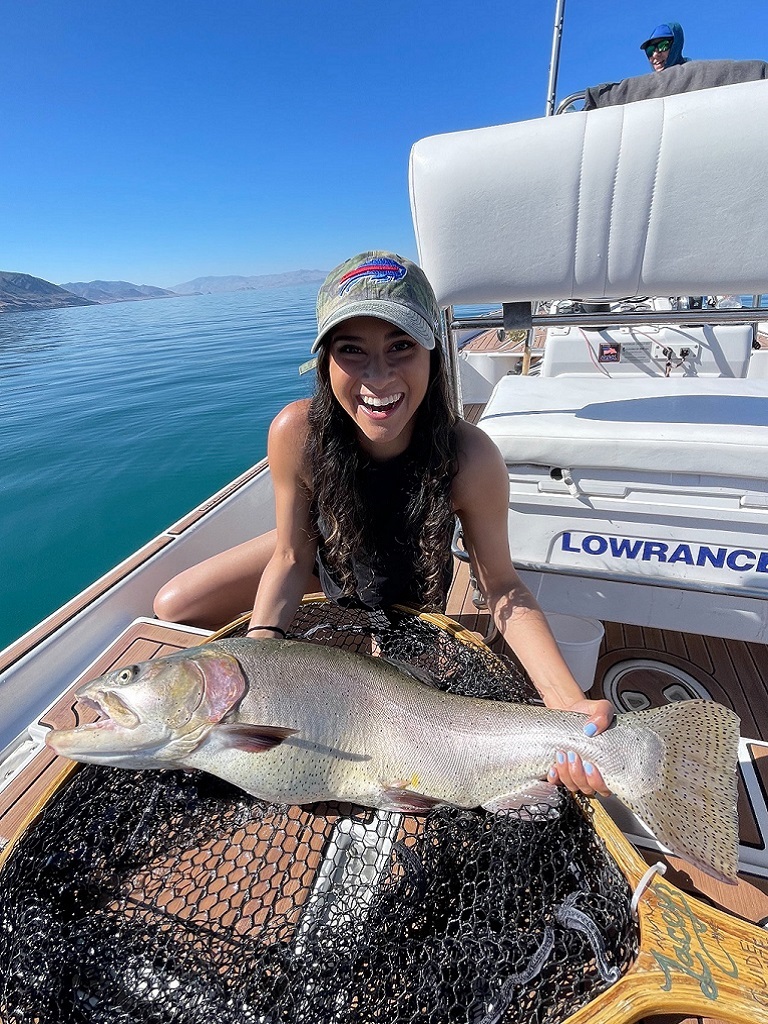
During June 2026 alone, our anglers landed more than 25 fish over 20 pounds.
Pilot Peak Lahontan Cutthroat are once again moving from Pyramid Lake into the Truckee River. And every season we’re learning more about where these remarkable fish go, what they eat and how to catch them.
You may not catch 30 trout.
You may not catch 20.
But the next time your indicator disappears, your line comes tight on the retrieve or your rod loads up fishing deep beneath the boat, you could be connected to a fish that anglers once thought Pyramid Lake might never produce again.
The giants are back.
Pyramid Lake is no longer primarily a numbers lake. It’s a size lake. And there may be no other trout fishery quite like it.
Ready to put these techniques to work on the water? Fish Pyramid Lake with an experienced Pyramid Lake fly fishing guide and take advantage of boat access, modern electronics, and the ability to fish productive water throughout the season.

He is a United States Coast Guard Boat Captain and is now in his 6th year of fly fish guiding from a boat at Pyramid Lake.
Hans has learned throughout the years of guiding that the best way to navigate through the water to ensure every day on the lake is something to remember! “If you love what you do, you’ll never work a day in your life.” This is the core foundation of his company, Lacey’s Guide Service.
